Research Notes
  • Posts
  • Profile

Distances on the unit sphere

Yuta Okamoto

2026-11-04

Abstract

A sample post that shows every statement environment of the site, with short statements about the great-circle distance and the chordal distance on the unit sphere.

Table of Contents

  • Setting
  • Chord and arc
  • Examples
  • Problems
  • Solutions

This post shows every statement environment of the site. The statements with a filled background are marked as new only to show the style.

Setting

Let ⟨x,y⟩=x1y1+x2y2+x3y3\left\langle x, y \right\rangle = x_1 y_1 + x_2 y_2 + x_3 y_3 be the standard inner product on ℝ3\mathbb{R}^3 and ‖x‖=⟨x,x⟩1/2\left\lVert x \right\rVert = \left\langle x, x \right\rangle^{1/2} the Euclidean norm. Let S2={x∈ℝ3:‖x‖=1}S^2 = \left\lbrace x \in \mathbb{R}^3 : \left\lVert x \right\rVert = 1 \right\rbrace be the unit sphere. For p,q∈S2p, q \in S^2, let dℝ3(p,q)=‖p−q‖d_{\mathbb{R}^3}\left(p, q\right) = \left\lVert p - q \right\rVert be the chordal distance.

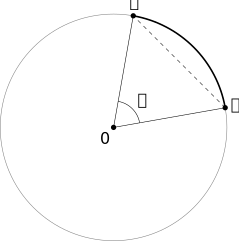
Definition 1 Great-circle distance. For p,q∈S2p, q \in S^2, the Cauchy–Schwarz inequality gives |⟨p,q⟩|≤1\left\lvert \left\langle p, q \right\rangle \right\rvert \leq 1. The great-circle distance between pp and qq is dS2(p,q)=arccos⁡⟨p,q⟩d_{S^2}\left(p, q\right) = \arccos \left\langle p, q \right\rangle, where arccos⁡:[−1,1]→[0,π]\arccos : \left[-1, 1\right] \to \left[0, \pi\right].

Figure 1: The great circle through pp and qq, and the angle θ=dS2(p,q)\theta = d_{S^2}\left(p, q\right). The thick arc has length dS2(p,q)d_{S^2}\left(p, q\right) and the dashed segment has length dℝ3(p,q)d_{\mathbb{R}^3}\left(p, q\right).

Assumption 2 Hemisphere. The points p,q∈S2p, q \in S^2 satisfy ⟨p,q⟩≥0\left\langle p, q \right\rangle \geq 0.

Chord and arc

Lemma 3. For all p,q∈S2p, q \in S^2, dℝ3(p,q)2=2−2cos⁡dS2(p,q)d_{\mathbb{R}^3}\left(p, q\right)^{2} = 2 - 2 \cos d_{S^2}\left(p, q\right) holds.

Proof. By the bilinearity and the symmetry of the inner product, ‖p−q‖2=‖p‖2−2⟨p,q⟩+‖q‖2\left\lVert p - q \right\rVert^{2} = \left\lVert p \right\rVert^{2} - 2 \left\langle p, q \right\rangle + \left\lVert q \right\rVert^{2} holds. Since ‖p‖=‖q‖=1\left\lVert p \right\rVert = \left\lVert q \right\rVert = 1, the right-hand side equals 2−2⟨p,q⟩2 - 2 \left\langle p, q \right\rangle. By Definition 1, cos⁡dS2(p,q)=⟨p,q⟩\cos d_{S^2}\left(p, q\right) = \left\langle p, q \right\rangle holds.□

Theorem 4 Chord and arc. For all p,q∈S2p, q \in S^2, the following identity holds.

dℝ3(p,q)=2sin⁡dS2(p,q)2 d_{\mathbb{R}^3}\left(p, q\right) = 2 \sin \frac{d_{S^2}\left(p, q\right)}{2}(1)

Proof of Theorem 4. Let θ=dS2(p,q)\theta = d_{S^2}\left(p, q\right). By Lemma 3 and the double-angle formula cos⁡θ=1−2sin2⁡(θ/2)\cos \theta = 1 - 2 \sin^{2} \left(\theta / 2\right), the following holds.

dℝ3(p,q)2=2−2cos⁡θ=4sin2⁡θ2 d_{\mathbb{R}^3}\left(p, q\right)^{2} = 2 - 2 \cos \theta = 4 \sin^{2} \frac{\theta}{2}

Since 0≤θ≤π0 \leq \theta \leq \pi, sin⁡(θ/2)≥0\sin \left(\theta / 2\right) \geq 0 holds, and taking the nonnegative square roots gives Equation 1.□

Question 5. For p,q∈S2p, q \in S^2 with p≠qp \neq q, how small can the ratio dℝ3(p,q)/dS2(p,q)d_{\mathbb{R}^3}\left(p, q\right) / d_{S^2}\left(p, q\right) be?

Proposition 6. For all p,q∈S2p, q \in S^2, the following inequalities hold.

2πdS2(p,q)≤dℝ3(p,q)≤dS2(p,q) \frac{2}{\pi} d_{S^2}\left(p, q\right) \leq d_{\mathbb{R}^3}\left(p, q\right) \leq d_{S^2}\left(p, q\right)

Proof. Let t=dS2(p,q)/2t = d_{S^2}\left(p, q\right) / 2, so that 0≤t≤π/20 \leq t \leq \pi / 2. By Theorem 4, dℝ3(p,q)=2sin⁡td_{\mathbb{R}^3}\left(p, q\right) = 2 \sin t holds, so it suffices to show (2/π)t≤sin⁡t≤t\left(2 / \pi\right) t \leq \sin t \leq t. The function s↦s−sin⁡ss \mapsto s - \sin s vanishes at s=0s = 0 and has the nonnegative derivative 1−cos⁡s1 - \cos s, so sin⁡t≤t\sin t \leq t holds. The second derivative −sin⁡s-\sin s of sin⁡\sin is nonpositive for 0≤s≤π/20 \leq s \leq \pi / 2, so sin⁡\sin is concave on [0,π/2]\left[0, \pi / 2\right]. Let λ=2t/π\lambda = 2 t / \pi, so that 0≤λ≤10 \leq \lambda \leq 1. The concavity at the points 00 and π/2\pi / 2 gives the following inequality.

sin⁡t=sin⁡(λπ2+(1−λ)0)≥λsin⁡π2+(1−λ)sin⁡0=2πt \sin t = \sin \left(\lambda \frac{\pi}{2} + \left(1 - \lambda\right) 0\right) \geq \lambda \sin \frac{\pi}{2} + \left(1 - \lambda\right) \sin 0 = \frac{2}{\pi} t □

Corollary 7. Let p,q∈S2p, q \in S^2 satisfy Assumption 2. Then dS2(p,q)≤π/2d_{S^2}\left(p, q\right) \leq \pi / 2 and dℝ3(p,q)≤2d_{\mathbb{R}^3}\left(p, q\right) \leq \sqrt{2} hold.

Proof. Since arccos⁡\arccos is decreasing and ⟨p,q⟩≥0\left\langle p, q \right\rangle \geq 0, dS2(p,q)=arccos⁡⟨p,q⟩≤arccos⁡0=π/2d_{S^2}\left(p, q\right) = \arccos \left\langle p, q \right\rangle \leq \arccos 0 = \pi / 2 holds. Since sin⁡\sin is increasing on [0,π/4]\left[0, \pi / 4\right], Theorem 4 gives dℝ3(p,q)=2sin⁡(dS2(p,q)/2)≤2sin⁡(π/4)=2d_{\mathbb{R}^3}\left(p, q\right) = 2 \sin \left(d_{S^2}\left(p, q\right) / 2\right) \leq 2 \sin \left(\pi / 4\right) = \sqrt{2}.□

Examples

Example 8. Let p=(1,0,0)p = \left(1, 0, 0\right) and q=(−1,0,0)q = \left(-1, 0, 0\right). Then ⟨p,q⟩=−1\left\langle p, q \right\rangle = -1, so dS2(p,q)=πd_{S^2}\left(p, q\right) = \pi and dℝ3(p,q)=2d_{\mathbb{R}^3}\left(p, q\right) = 2 hold. Both sides of the left inequality of Proposition 6 equal 22 for this pair, so the coefficient 2/π2 / \pi cannot be replaced by a larger number.

Example 9. Let p=(1,0,0)p = \left(1, 0, 0\right) and q=(0,1,0)q = \left(0, 1, 0\right). Then ⟨p,q⟩=0\left\langle p, q \right\rangle = 0, so the pair satisfies Assumption 2, and dS2(p,q)=π/2d_{S^2}\left(p, q\right) = \pi / 2 and dℝ3(p,q)=2d_{\mathbb{R}^3}\left(p, q\right) = \sqrt{2} hold. Hence both bounds of Corollary 7 are attained.

Check 10. Let p=(1,0,0)p = \left(1, 0, 0\right) and q=(1/2,1/2,0)q = \left(1 / \sqrt{2}, 1 / \sqrt{2}, 0\right). Compute both sides of Equation 1.

Solution. Since ⟨p,q⟩=1/2\left\langle p, q \right\rangle = 1 / \sqrt{2}, dS2(p,q)=π/4d_{S^2}\left(p, q\right) = \pi / 4 holds. The coordinates and the formula sin2⁡(θ/2)=(1−cos⁡θ)/2\sin^{2} \left(\theta / 2\right) = \left(1 - \cos \theta\right) / 2 for θ∈ℝ\theta \in \mathbb{R} give the following.

dℝ3(p,q)2=(1−12)2+(12)2=2−2=4sin2⁡π8 d_{\mathbb{R}^3}\left(p, q\right)^{2} = \left(1 - \frac{1}{\sqrt{2}}\right)^{2} + \left(\frac{1}{\sqrt{2}}\right)^{2} = 2 - \sqrt{2} = 4 \sin^{2} \frac{\pi}{8}

Hence both sides equal (2−2)1/2\left(2 - \sqrt{2}\right)^{1/2}.

Check 11. For p∈S2p \in S^2, compute dS2(p,p)d_{S^2}\left(p, p\right) and dℝ3(p,p)d_{\mathbb{R}^3}\left(p, p\right).

Solution. Since ⟨p,p⟩=‖p‖2=1\left\langle p, p \right\rangle = \left\lVert p \right\rVert^{2} = 1, dS2(p,p)=arccos⁡1=0d_{S^2}\left(p, p\right) = \arccos 1 = 0 holds. By definition, dℝ3(p,p)=‖p−p‖=0d_{\mathbb{R}^3}\left(p, p\right) = \left\lVert p - p \right\rVert = 0 holds.

Problems

Question 12. For which pairs p,q∈S2p, q \in S^2 does dℝ3(p,q)=dS2(p,q)d_{\mathbb{R}^3}\left(p, q\right) = d_{S^2}\left(p, q\right) hold?

Exercise 13. Show that dℝ3(p,q)≤2d_{\mathbb{R}^3}\left(p, q\right) \leq 2 holds for all p,q∈S2p, q \in S^2, with equality if and only if q=−pq = -p.

Hint. Use Lemma 3 and compute ‖p+q‖2\left\lVert p + q \right\rVert^{2}.

Exercise 14. Let AA be a real 3×33 \times 3 matrix with A⊤A=IA^{\top} A = I, where A⊤A^{\top} is the transpose of AA and II is the identity matrix. Show that Ap∈S2A p \in S^2 and dS2(Ap,Aq)=dS2(p,q)d_{S^2}\left(A p, A q\right) = d_{S^2}\left(p, q\right) hold for all p,q∈S2p, q \in S^2.

Remark 15. The function θ↦2sin⁡(θ/2)\theta \mapsto 2 \sin \left(\theta / 2\right) is strictly increasing on [0,π]\left[0, \pi\right]. Hence, by Theorem 4, for all p,q,r,s∈S2p, q, r, s \in S^2, dS2(p,q)≤dS2(r,s)d_{S^2}\left(p, q\right) \leq d_{S^2}\left(r, s\right) holds if and only if dℝ3(p,q)≤dℝ3(r,s)d_{\mathbb{R}^3}\left(p, q\right) \leq d_{\mathbb{R}^3}\left(r, s\right) holds.

Open Problem 16 Tammes problem. Determine, for every integer N≥2N \geq 2, the maximum of min1≤i<j≤N⁡dS2(pi,pj)\min_{1 \leq i < j \leq N} d_{S^2}\left(p_i, p_j\right) over p1,…,pN∈S2p_1, \dots, p_N \in S^2.

Open Problem 17 Thomson problem. Determine, for every integer N≥2N \geq 2, the minimum of ∑1≤i<j≤N1/dℝ3(pi,pj)\sum_{1 \leq i < j \leq N} 1 / d_{\mathbb{R}^3}\left(p_i, p_j\right) over pairwise distinct p1,…,pN∈S2p_1, \dots, p_N \in S^2.

Solutions

Solution of Exercise 13. By Lemma 3, dℝ3(p,q)2=2−2cos⁡dS2(p,q)≤4d_{\mathbb{R}^3}\left(p, q\right)^{2} = 2 - 2 \cos d_{S^2}\left(p, q\right) \leq 4 holds, so dℝ3(p,q)≤2d_{\mathbb{R}^3}\left(p, q\right) \leq 2. Equality holds if and only if ⟨p,q⟩=cos⁡dS2(p,q)=−1\left\langle p, q \right\rangle = \cos d_{S^2}\left(p, q\right) = -1. Since ‖p+q‖2=2+2⟨p,q⟩\left\lVert p + q \right\rVert^{2} = 2 + 2 \left\langle p, q \right\rangle, this holds if and only if p+q=0p + q = 0, that is, q=−pq = -p.

Solution of Exercise 14. Since A⊤A=IA^{\top} A = I, ⟨Ax,Ay⟩=⟨x,A⊤Ay⟩=⟨x,y⟩\left\langle A x, A y \right\rangle = \left\langle x, A^{\top} A y \right\rangle = \left\langle x, y \right\rangle holds for all x,y∈ℝ3x, y \in \mathbb{R}^3. Taking x=y=px = y = p gives ‖Ap‖=‖p‖=1\left\lVert A p \right\rVert = \left\lVert p \right\rVert = 1, so Ap∈S2A p \in S^2. Taking x=px = p and y=qy = q gives dS2(Ap,Aq)=arccos⁡⟨Ap,Aq⟩=arccos⁡⟨p,q⟩=dS2(p,q)d_{S^2}\left(A p, A q\right) = \arccos \left\langle A p, A q \right\rangle = \arccos \left\langle p, q \right\rangle = d_{S^2}\left(p, q\right).

  • Posts

  • Profile

© 2026 Yuta Okamoto